
Table of contents
🤖
AI-generated summary
Alright, I’m going through things in chronological order of acquisition and sale to back up my Gear Acquisition Syndrome diagnosis…
As a reminder, I traded my A7C for the X100V — I won’t go back over the reasons that pushed me to do that, but I’ll try to give you my honest take by comparing the X100V to the A7C.
As always, my articles are not affiliated or sponsored — I bought everything with my own money.
Ergonomics
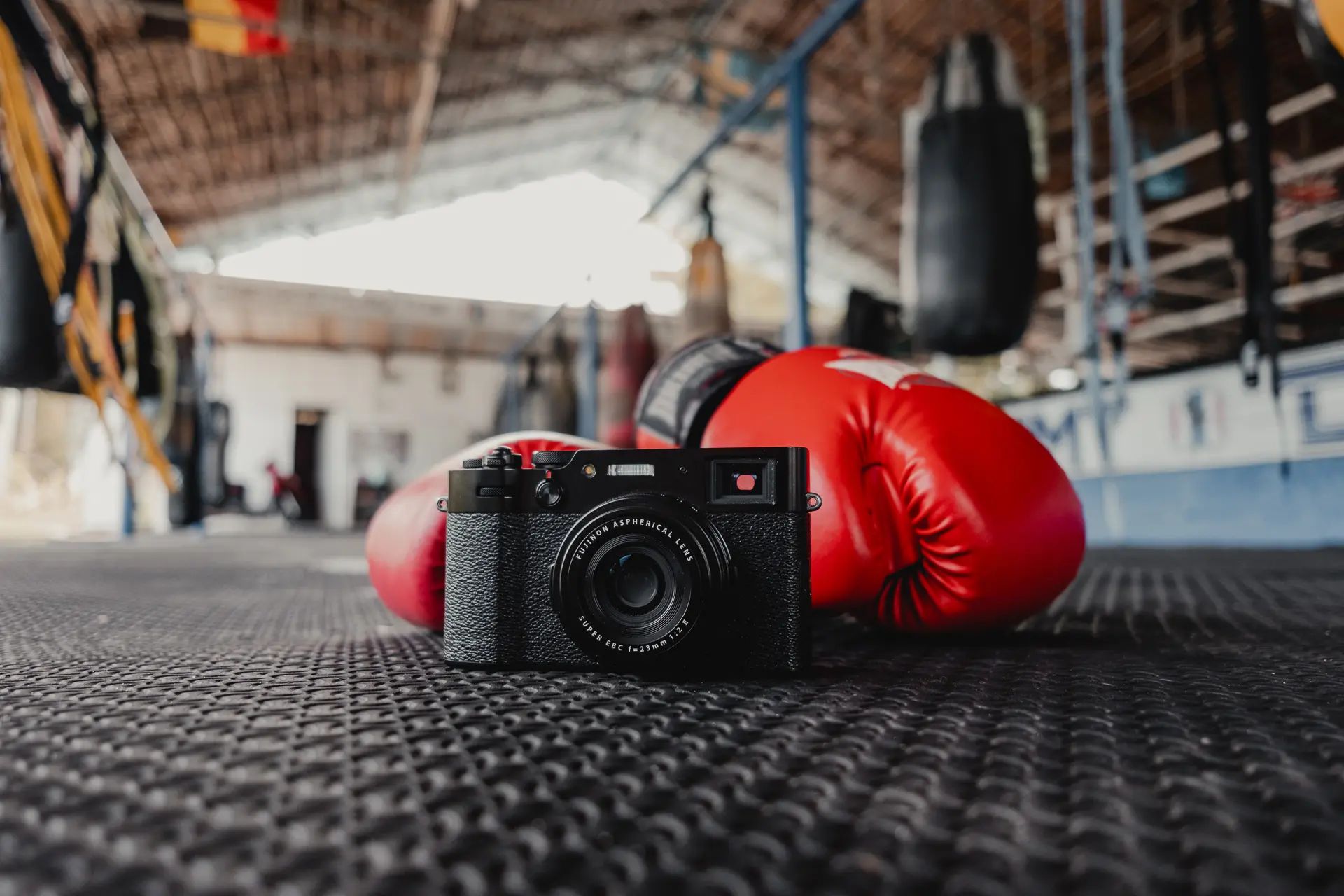
If you buy a Fujifilm, it’s first and foremost for the ergonomics. On that front, it’s a flawless performance — even with such a small body, the handling is immediately intuitive. Manual focusing is a little awkward with such a small lens, but it’s a detail that won’t really bother you day to day.
I love the optical viewfinder — it’s a photographic experience you really have to try. The small electronic viewfinder that overlays onto the optical one adds a great deal of satisfaction to taking photos.
You can’t quite imagine how strange it feels to be able to see through a camera viewfinder when the camera is turned off 😅.
There aren’t a ton of customizable buttons, but there are all the dials you need to adjust shutter speed, ISO, or the aperture ring on the lens. It’s a real pleasure to have physical controls rather than delegating all of that to a touchscreen. Camera off, you immediately know what settings you’re on.
The body is relatively small, which lets you slip it into the pocket of a roomy jacket. Forget your jeans pocket…
Autofocus and Focusing
As I was saying, focusing with the optical viewfinder is a treat — you can focus manually or let the camera handle it. In the first case, manual focus isn’t to my taste because the focus ring is relatively small on the lens. Nothing like the pleasure you get when manually focusing with a Leica Q, for example.
Autofocus is clearly a step below Sony… Forget action shots — you’ll need several tries to make sure your kids or pets aren’t blurry. Then again, can you really blame the camera? Is this type of camera meant for those kinds of shots?
The minimum focusing distance of 10cm is very welcome given the absence of a macro mode (unlike the Leica Q).
The Fixed Lens
The fixed lens is great for feeding the small 26MP sensor — it’s very (too?) slim, and the photos that come out of it are genuinely excellent compared to what I could get with the A7C. Depth of field aside, obviously.
The Fujinon 23mm f/2.0 is the equivalent of roughly 35mm on full frame. It’s a reportage focal length, but it can feel too tight in certain situations — especially when traveling and trying to photograph architecture or landscapes.
With such a small sensor, cropping won’t get you very far — 50mm max.
That’s the constraint you need to know before buying this camera: your zoom is your feet, and sometimes that just won’t cut it. Want to photograph Mickey Mouse behind a frenzied crowd? Forget it!
Battery Life and Charging
This is the camera’s weak point — the battery life is struggling. It reminds me of the early Sony A7 days, where you had to remember to throw a second battery in your bag to be sure of making it through the day.
On the plus side for charging though: despite the absence of a charger (becoming the norm everywhere, even on phones), Fujifilm thought to include a USB-C port. This port, which is now very common, lets me charge the camera while offloading photos to my computer at the same time.
That might sound trivial — getting excited about a USB port that charges the camera. Well, know this: the Leica Q at €5,000 cannot be charged via its USB port…
Miscellaneous
The app is pretty well designed — you can trigger the shutter remotely.
I like the ability to transfer GPS coordinates; I didn’t expect Fujifilm to be on top of that kind of feature, but it seems to work at least as well as on the Sony A7 lineup.
But as I mentioned above, the main problem with this camera is its battery life — so if you leave the app connected to the camera, it will drain the battery like snow in the sun.
The Good, the Bad and the Ugly
The good: if you had to pick just one positive about this camera in one word — pleasure, the pleasure of taking photos. You have to at least try this camera for its hybrid viewfinder (the X100 series or XPRO).
The bad: one gripe — the shutter button feels unfinished, like Fujifilm was nudging you to buy a screw-on button accessory, and sure enough I fell for it. I find the button too small and positioned too low. The 35mm is too tight — a 28mm or 24mm with 60MP would handle more situations.
The ugly: the battery. Ever since the newer Sony A7III batteries and later ones came along, you completely forget to charge your cameras. On the X100V, it drains fast even if you stick to just the optical viewfinder. And that autofocus! What a 💩
In summary, the Fujifilm X100V is a beautiful camera, designed for the pleasure of photography. But if you’re after efficiency, battery life, and versatility, you’re better off looking at the Sony A7C. The X100V is a love-at-first-sight camera — but not a daily companion.
I’m not sure whether the X100VI fixes the battery and autofocus issues; I have however read that the lens is no longer suited to the new sensor… For me, the X100 series is overrated — far too expensive for what it delivers. If you’re wondering what I bought next: I went back to Sony with the A7c (better battery, better autofocus, etc.).
FAQ
- Is the Fujifilm X100V suited to travel photography?
Clearly not, in my opinion — you’ll likely feel frustrated by the 35mm and the impossibility of cropping with such a small sensor. It’s a reportage camera. Trying to photograph architecture inside a cathedral can be genuinely frustrating at 35mm.
- Can you use the Fujifilm X100V to photograph children?
No. Move on… Or accept a lot of wasted shots because of the sluggish autofocus. Again, the 35mm isn’t suited to that kind of photography.
- What’s an alternative to the Fujifilm X100V in 2025?
A XE5 while waiting for an X-PRO 4, or else an A7c… Honestly, if you want to save a few millimeters, just get a camera with interchangeable lenses! You won’t regret it.