
Table of contents
🤖
AI-generated summary
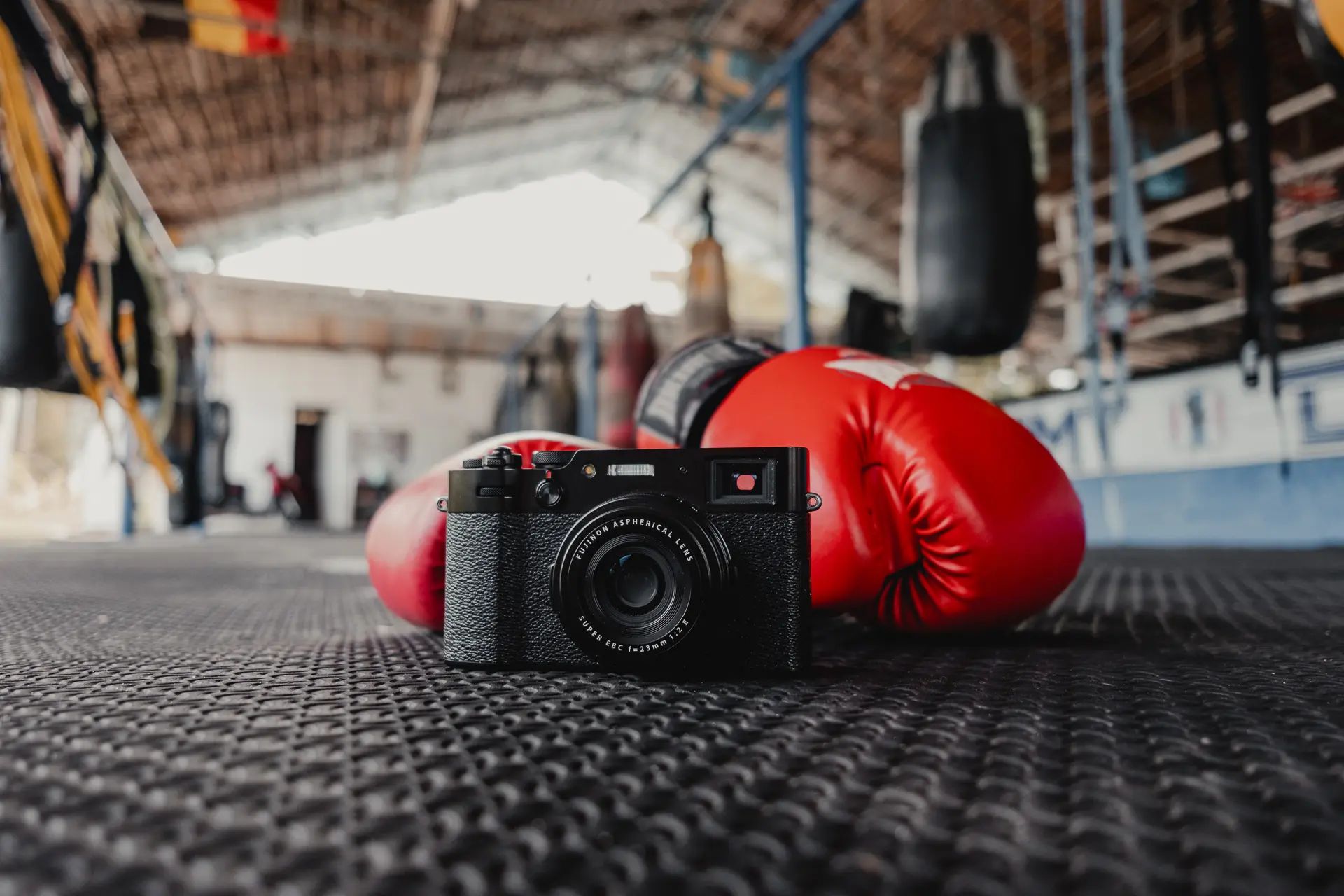
The Fujifilm X-E5 is appealing, but the price is enough to make you cough. The X-E4 kit used to go for around €1,000; today we are at €1,570. In exchange, Fuji ships it with a new 23mm f/2.8, a 35mm full-frame equivalent.
I spent a few days with it. Spoiler: it’s almost the camera I’ve been looking for…
Portability, My Only Real Criterion
With its 23mm pancake lens, the X-E5 is tiny. It’s exactly what I want: a camera you can carry with you at all times, without thinking, without a bag. This has become my number one buying criterion.

Because I realized something. I take my best photos when I’ve planned to take pictures, on a trip or at home. When I head out spontaneously, I leave the camera behind: too bulky, and I don’t feel like carrying a bag. A body this size solves that problem.
Ergonomics, Battery, Build: So Close to Flawless
My first complaint: Fuji could have made it a few centimeters wider. With such a short body, your fingers end up cramped trying to hold it. The length of the X100 would have been perfect.
And that extra width would have solved the real tragedy: the battery life. You peak at around 300 shots. In 2026, on a €1,500+ camera that’s supposed to follow you everywhere, that’s unacceptable. A few extra millimeters would have made room for the new battery and decent endurance. I experienced the same frustration on the Leica M EV1 , at a much steeper price tag.
The viewfinder is a bit small and the resolution is just okay, but that’s the price you pay for compactness, and a larger EVF would have drained the battery even faster. The articulating screen lets you take self-portraits, which is nice. As for the build quality, no complaints: it never feels cheap or hollow. Keep in mind, though, it’s not weather-sealed, so watch out for rain and dust.
The Real Problem: The Lenses
Here’s my rant. Fuji makes ultra-compact camera bodies, but releases lenses designed for a pro lineup. The result: they are massive, completely defeating the purpose of a camera like this.
So you have to fall back on older lenses. The 18mm f/2, whose autofocus makes you want to cry. Or the 35mm f/1.4, which is still too big for my taste. Fuji has a target audience problem: they want to appeal to everyone when it comes to camera bodies, which is great. But not everyone is a pro, and not everyone needs peak image quality or the fastest autofocus—which means we don’t all need a bazooka for a lens.
Things are starting to shift slowly thanks to Chinese manufacturers, who are releasing the compact lenses Fuji refuses to make. This is exactly what won me over in M-mount with Voigtländer . In the meantime, the lens ecosystem remains a weak spot.
Autofocus: Fuji is Still Lagging Behind
A camera like this is meant to be used with autofocus. And when you come from Sony, you immediately feel how far behind Fuji is. On a Sony, you turn on continuous tracking with eye detection, and you don’t even have to look through the viewfinder anymore: just press the shutter and the photo is sharp, even with a kid running in all directions.
This is almost impossible to replicate on a Fuji in 2026. I already noticed this when switching from Sony to Fujifilm , and the gap hasn’t really narrowed.

The Simulation Dial: A Failed Good Idea
Fuji tried to innovate with a dedicated film simulation dial. On paper, it’s great. In practice, the implementation is a miss: you only get three configurable slots for your own custom settings. The other notches lock you into default simulations that can’t be customized.
What would have been great is a dial that gives access to all my custom recipes. My custom-tuned Classic Chrome, my custom Classic Negative, and so on. As it stands, it feels like a half-baked job.
So, Am I Keeping It?
If you’re just looking for a portable camera, go straight for a X100: just as portable, better built, and with slightly better battery life around 400 shots. The X-E5 retains the advantage of interchangeable lenses, but lacks any real compact lens option for now.

Where it really makes sense is if you’re willing to settle for the 23mm f/2.8 as your daily driver. Forget about nice background bokeh, but you keep the option of screwing on a chunky 56mm f/1.2 for portraits on days you don’t feel like leaving the house. And let’s be honest: paired with the 35mm f/1.4 , this little body produces exceptional images.
In short, the X-E5 is incredibly close to being the perfect compact camera. It all comes down to whether you can forgive the battery life and the autofocus. If you end up changing your mind like I did, you already know how to properly sell your gear .
Any questions? Feel free to reach out.