

Table of contents
🤖
AI-generated summary
I’ve been shooting for about ten years. I’ve always used Sony cameras, or nearly (Alpha 77, 99, A7R , A7 II, A7 III, A7C , RX100 VII) — the list is long, as you can see.
I recently parted with my A7C . I realised that swapping lenses while travelling with kids is a dangerous sport 😨. And then there’s the mental fatigue of constantly asking yourself “did I bring the right lens?”, “what if I had my zoom?”, “the quality would definitely be better with my 24mm f/1.4”.
Not to mention the gear acquisition syndrome — you always want the newest, fastest lens. Once you’ve bought it, you realise it’s too big, so you sell it, then buy it back, then finally it’s too heavy so you sell it again…
I don’t know if you recognise yourself in that behaviour, but for me the only solution I found was to part with my A7C — definitively, or not (never say never).

But after 10 years of photography, even with my ongoing challenge of shooting exclusively with my iPhone , the urge to have a proper camera is strong.
After my stint with the Leica Q, I was looking for a capable camera — the smallest possible without sacrificing too much in terms of quality and sensor size. The new Sony A7C seemed ideal, and it was. So why did I sell it?
Sony is a great brand, with great engineers, and they make technically the best cameras. But the build quality and design of their bodies is nothing special, let alone the handling.
There’s no joy or emotion when you pick up a Sony body. You know you’re going to get great shots, nothing will be wasted (extraordinary autofocus). In the end, that lack of emotion pushed me to try shooting exclusively with my phone — and in certain situations it does the job perfectly well, but the emotion isn’t there either.
A Leica is way out of my budget. The Leica Q doesn’t have the right focal length — the 28mm distorts people too much in portrait shots. A Leica Q at 35mm would be genuinely interesting, but the price would be out of reach regardless.
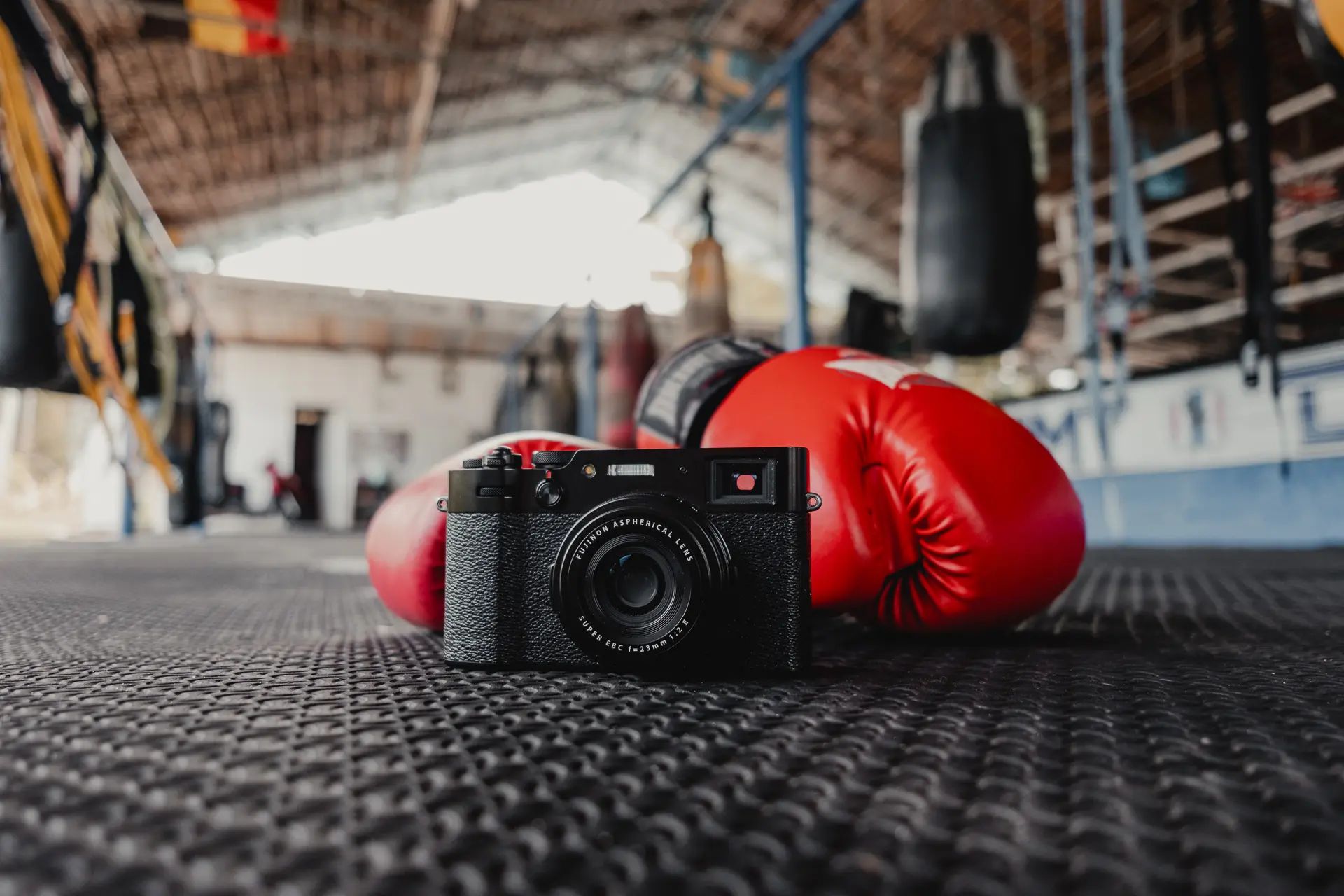
I looked at Fujifilm — I call it the poor man’s Leica — and I think their lineup is really well thought out. There’s something for everyone, and most importantly no single body has exclusive access to the best sensor or features. They’re all at a relatively similar technical level; only the bodies differ, designed for different types of photographers. The X-Pro bodies are beautiful, but as I said earlier, I’d like to drop the whole “which lens?” dilemma. I don’t want to ask myself about focal length or aperture, and I want the most compact camera possible. The XE series is very attractive, but you lose the optical viewfinder. That viewfinder — which I’ve never experienced (I’ve never shot on film) — really piques my curiosity. Which leaves only the X100 series from Fujifilm offering a hybrid viewfinder with a fixed lens. The X100V is therefore the one I set my sights on.
I’m increasingly recognising myself in the Fujifilm philosophy: pick a film — meaning choose a film simulation — and then just shoot. I’ve always shot in RAW, and this will be the first time I abandon that format in favour of film simulations, just like the film era. I’ll lock in a mood; I won’t see it in real time through the optical viewfinder; and I’ll keep that joy of anticipation — waiting to see what the film simulation brought to my shot.
You see the idea? I aim, I take the shot, and I can’t wait to see the result. Until now, my phones and Sony cameras gave me that information in real time — you just moved on to the next photo.
Fujifilm is first and foremost a beautiful object: a body with a multitude of physical dials that lets you step away from the screen entirely. I would have even liked Fujifilm to allow you to fully close the screen on the X100V — so you can’t even see the result in real time, like the XPRO3. Maybe in the next iteration of the X100, who knows.